
Crypto Slang Dictionary: From FOMO to RWA — A Beginner’s Guide
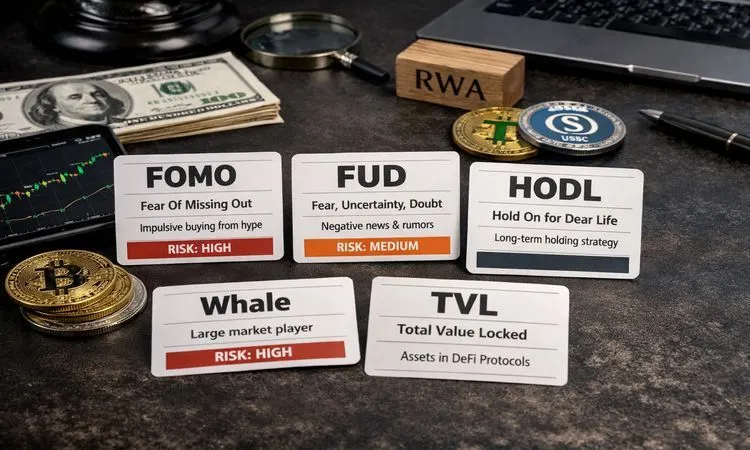
The crypto world has its own language.
Newcomers jump in, see endless abbreviations, memes, and English tweets — and think:
“What is even happening here?”
Relax — everyone has been there.
The key is learning the basic terms, and suddenly it becomes much easier to navigate chats, news, and trading.
Below is an alphabetical breakdown of the most important crypto words and metrics as of February 2026.
📌 The market is in an interesting phase right now: Bitcoin is holding around 68–69k, RWA keeps growing (tokenized assets are already above 24B), and DeFi remains strong despite the broader correction.
| Term | Meaning | Risk Level |
|---|---|---|
| FOMO | Fear of missing out | High (leads to impulsive buys) |
| FUD | Fear, uncertainty, doubt | Medium (often manipulation) |
| HODL | Holding long-term | Medium (depends on the asset) |
| Whale | Big player moving the market | High (can trigger pumps/dumps) |
| Liquidity | Ease of buying/selling | Medium (critical in DeFi) |
| TVL | Value locked in a protocol | Low/Medium (trust indicator) |
| RWA | Tokenized real-world assets | Low/Medium (top trend of 2026) |
| DYOR | Do your own research | Essential |
FOMO (Fear Of Missing Out)
🔒 Important: emotional, impulsive trades often end in losses.
To protect yourself, keep this security guide handy:
🛡️ How Not to Lose Money in Crypto: A Security Checklist for 2026
Fear of missing an opportunity.
When you see BTC or some meme coin pumping 15–20% in a day while you’re sitting in fiat — that’s FOMO.
It pushes people to buy at the top, often with leverage.
💡 Tip: If FOMO hits hard, step away from the screen for at least 24 hours. Most impulsive buys become expensive lessons.
FUD (Fear, Uncertainty, Doubt)
Fear, uncertainty, and doubt.
This is negative sentiment spread intentionally or accidentally to drive prices down: scary headlines, regulation rumors, whale dumps.
The antidote: DYOR — verify sources and don’t panic sell.
Markets often bounce back once FUD fades.
HODL (Hold On for Dear Life)
A legendary typo from 2013 that became a strategy: hold through everything.
It works well with Bitcoin and Ethereum, especially as institutions keep accumulating via ETFs.
⚠️ But not every altcoin deserves HODL.
If TVL is dropping and the team is silent, HODLing may turn into holding a dead asset.
Whale
A large holder whose trades can move the market.
This can be early miners, funds, or institutions like BlackRock.
Tracking whales via on-chain tools (Whale Alert, Arkham) often gives clues about upcoming pumps or dumps.
Liquidity
Liquidity means how easily you can buy or sell an asset without moving the price too much.
-
High liquidity: BTC on major exchanges
-
Low liquidity: small/new altcoins (slippage can cost 5–10%)
In DeFi, liquidity lives in pools where users provide assets and earn fees.
📉 A shallow order book = higher slippage.
TVL (Total Value Locked)
The total value of assets locked inside a DeFi protocol.
Higher TVL usually means stronger user trust.
📊 Track TVL on DeFiLlama: sudden outflows are a major red flag.
Stablecoins
Stablecoins are cryptocurrencies pegged to the US dollar or other real assets.
In 2026, they are the foundation of trading and DeFi.
-
USDT / USDC — classic stablecoins: basically a “digital dollar”
-
Yield-bearing RWA stablecoins (like USDY from Ondo) — backed by tokenized treasuries and generating yield
💡 In simple terms: USDT is stability, while USDY is stability + income.
RWA (Real World Assets)
Tokenization of real assets: real estate, bonds, gold, treasuries — all on-chain.
This is the hottest narrative of 2026.
Ethereum holds around 58% of the non-stablecoin RWA market, while projects like Ondo and BlackRock’s BUIDL are pulling in institutions.
RWA is the bridge between crypto and traditional finance — and it’s only getting bigger.
A Technical Touch (For Curious Readers)
Ratio = MCap ÷ TVL
If the value is > 1, the project may be overvalued.
💡 Experienced investors often use this metric to compare DeFi protocols.
From the Author
If you’re just entering crypto, don’t worry if everything feels chaotic.
This market really is like jazz: at first it sounds noisy and confusing, but over time you start hearing the rhythm.
I made this dictionary as a starting point so you can feel more confident in terms, news, and discussions.
The main rule is simple: don’t rush, don’t buy on emotions, and always think about security.
Thanks for reading Crypto-Jazz. Keep building 🤝
Final Thoughts
Crypto slang evolves fast, but these terms are the foundation you’ll see everywhere: Twitter, Telegram, forums, and market news.
Understand them — and you’ll stop feeling like an outsider.
Welcome to this crypto jazz. Keep building.