
Goldman's Treasury Fund Comes to Lynq Without Being Tokenized
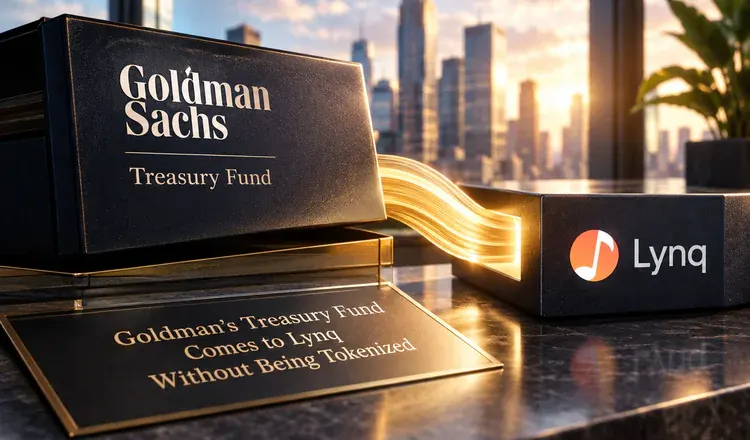
Goldman Sachs's largest government money-market fund became available to crypto trading firms on Monday, and it did so without being turned into a token. The Financial Square Treasury Instruments Fund, ticker FTIXX, is now distributed on Lynq, a permissioned Avalanche chain built by Arca Labs, Tassat and tZERO. Nothing about the fund itself changed. It is not wrapped or issued onchain; Lynq is a new channel for shares that already exist, with tZERO Securities, a registered broker-dealer, handling trades and eligibility checks. Access is limited to qualified US clients.
Two figures for one fund
The size of FTIXX depends on which account you read. CoinDesk, Markets Media and the tZERO announcement carried by Crowdfund Insider all put it at $100 billion. Unchained, publishing four hours after CoinDesk on Monday evening, gives $105 billion in net assets at the end of August, with $97.3 billion of that in institutional class shares. The two figures do not reconcile, and neither outlet states the as-of date the other is using. Unchained adds one line the others leave out: a separate Token Shares class, GDTXX, held about $10,400.
What sits on the network today
Lynq went live in July 2025 as a real-time, interest-bearing settlement network. The idea is that cash parked between trades earns a Treasury yield instead of sitting idle at a broker. More than 30 institutional firms have been onboarded. The named ones are B2C2, Wintermute, Galaxy, FalconX and Crypto.com, with CoinDesk adding Fireblocks and no other account in this sweep repeating that. Assets on the network are above $89 million. Set that against the fund being plugged into it and the distance is four orders of magnitude.
Jerald David, chief executive of Lynq, gave CoinDesk the commercial reason for adding it.
"Our clients were looking for a treasury asset on the platform that may have had a different yield profile than the other instrument that's on there right now," David said.
FTIXX is the second asset on Lynq, on CoinDesk's account, and no outlet retrieved here names the first. David told Unchained separately that the team "needed to demonstrate that there was client demand". The client base is US-only on that same account, which caps how far the channel can reach before anything else changes.
Tokenization is the word nobody used
The announcement sits oddly beside this year's tokenized-fund launches, because it does the opposite thing. Markets Media described the arrangement as bringing a traditional Treasury product together with tokenized real-time settlement, which is a claim about the rails and not about the fund. tZERO's own framing, in the statement Crowdfund Insider carried, is convergence between digital and traditional markets. A private Avalanche L1 does the settling; the share class stays ordinary. For a firm whose auditors balk at an onchain wrapper, that separation is the product. The yield comes from the fund, the speed from the chain underneath it, and the two are contracted separately.
The number that would show demand
Neither Goldman Sachs nor tZERO has published a target for how much of the fund could be held this way, and none of Monday's accounts gives an expected inflow. What the network holds is disclosed. What the fund contributes to it is not. tZERO, which licensed 103 patents to ICE this month, has not said when a third asset joins either. The next reading of the network's asset total is where any of this shows up.
Read also: Canada's Bank Regulator Says Tokenized Deposits Are Just Deposits