
Nakamoto Moves 60 Million USDT of Its Kraken Loan to December 2027
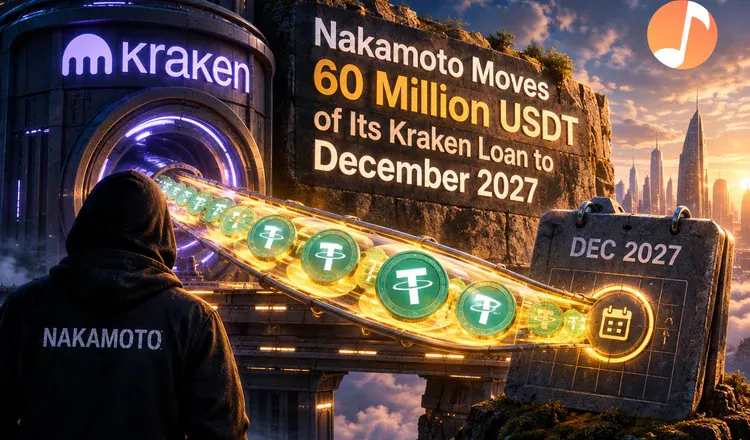
Nakamoto Inc. has bought itself a year. The bitcoin company's lending subsidiary signed a second amendment to its Kraken loan agreement on 11 November, moving 60 million USDT of a 165 million USDT principal from 4 December this year to 4 December 2027. The other 105 million USDT still falls due on 30 June 2027. Nothing is now scheduled to mature in 2026. Kraken also agreed to count the net value of Nakamoto's bitcoin derivatives positions as collateral.
What the filing says and what it does not
The terms come from Nakamoto's own Form 8-K, filed on Thursday, so they do not rest on a summary. The master loan agreement with Payward Interactive, which does business as Kraken, dates from 3 December 2025 and was amended once in January. The 165 million USDT sits under a separate fixed-term facility the filing calls the June Loan.
CoinDesk, reporting the amendment early on Friday, describes one continuous facility that started last December at $210 million and 8% a year. The filing does not use that framing and does not mention $210 million. Neither account says whether the June loan replaced the earlier borrowing or sat beside it. We could not establish which reading is right.
"This amendment extends our runway and makes our collateral position more resilient," said Tyler Evans, Nakamoto's chief investment officer.
How the options count
The collateral change is the more consequential half. Kraken now values Nakamoto's pledged derivatives positions daily and lets the net figure count toward the tests that trigger a collateral call or a liquidation. A put option is a contract that pays out if the price falls, so a book of them gains value as the pledged coins lose it. The filing says the intent is to let such positions offset declines before the borrower has to post more coins.
Two limits travel with that, and a third sits underneath. A negative net value counts as zero, and the figure counts for triggering calls but not for getting collateral back. Kraken alone determines it. Nakamoto's own risk disclosure puts the exposure plainly: the included value "may be limited or zero, is determined by the lender, and may be excluded in certain circumstances".
The figures that rest on one account
How much room the amendment buys is a separate question, and the numbers come from one outlet. CoinDesk puts Nakamoto's market value at about $104 million after Thursday's close at $5.79, below what the company owes. It reports 3,030 of the firm's 4,283 bitcoin pledged to Kraken at the end of September. At Friday's price under $69,000 those coins come to roughly $208 million, about 126% of the debt by its calculation. None of it appears in a second account.
The hedge is thinner than it sounds. At the end of September the firm had sold calls on 2,150 bitcoin and bought puts on 2,000 bitcoin at $55,000, CoinDesk reports from the quarterly filing. The whole book was worth minus $6 million at quarter-end, which under the new terms would have counted as nothing. Those puts expire on 25 December, six months before the earlier of the two maturities.
A second balance sheet doing the same arithmetic
BTCS, a Nasdaq-listed company that holds ether, spent the week in the same position from the other side of the market. It told investors on Thursday that it owed about $64.1 million on Aave, the lending protocol where a loan is closed out by code and not a phone call, and that it had been selling ether below what it paid to keep clear of that line. CoinDesk puts the automatic liquidation point near $1,717 an ether on the 9 November figures, about 12% below Friday's price, and notes the position may have moved since. BTCS had about $463,000 of cash at the end of September. The account is CoinDesk's alone, and the company did not say how much ether it sold.
Nakamoto's calendar is clear until June 2027 and its collateral now has a hedge inside it. Neither change pays anything down. The 165 million USDT is still owed, and the puts run out at Christmas. What the filing does not say is what the company does after that.
Read also: MSCI Adopts a Non-Operating Screen That Could Drop Strategy in November