
Apple – A Genius Plan for Dominance Without Intel
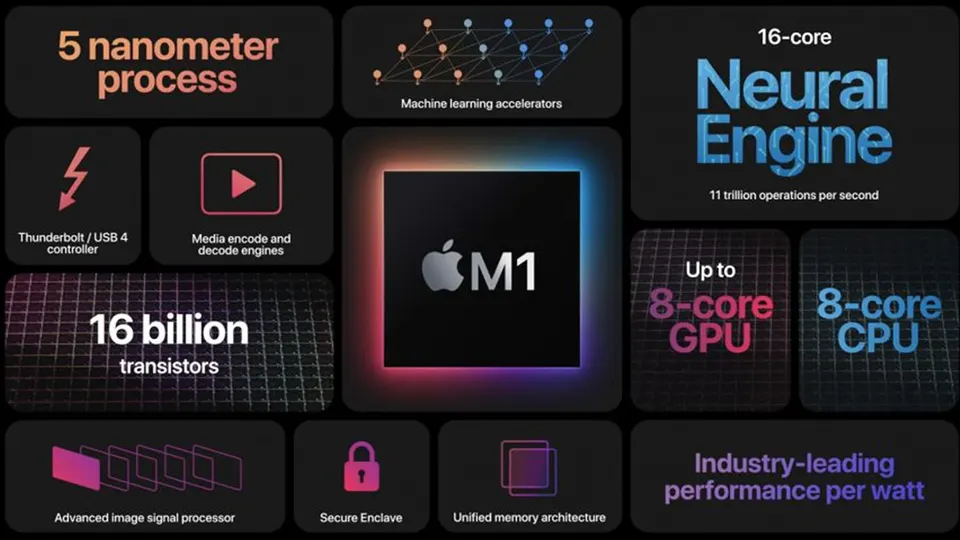
At its annual developer conference, Apple made a sensational announcement: the Mac will transition to ARM processors designed by Apple, aiming to permanently move away from Intel.
Transition to the New “Apple Silicon”
The shift to what the company calls “Apple Silicon” brings significant advantages to future devices and will free Apple from Intel chips for its hardware. This move will allow Apple to upgrade MacBooks without being constrained by Intel. The company expects the first devices based on its own processors to be available this year.
Advantages of ARM-based processors:
- Higher performance
- Energy efficiency
- Lower heat generation compared to Intel counterparts.
With the new processors, Apple will be able to create thinner and lighter laptops that last longer on a single charge and do not require cooling, even when running complex tasks like Photoshop or application programming.
But most importantly, Apple will be able to fully control its future for the first time by designing every element of its hardware independently. The benefits are clear, but transitioning to a new processor architecture is a major event that affects every application, including Apple’s own software. Developers will need to recompile their apps and apply new coding techniques compatible with ARM processors for them to work properly on the new hardware. This means that many older apps may stop functioning.
Adapting Applications or Sales: Chicken or Egg?
This presents a classic “chicken or egg” problem: for customers to want to buy an ARM-based computer, enough apps must be adapted. To reprogram the apps, developers need access to available hardware and must be convinced that the investment will pay off and that customers will follow the ARM transition.
Microsoft has faced a similar challenge for years in its attempts to transition to ARM-based processors. The Surface Pro X, released in 2019 with an ARM processor designed by Microsoft, encountered its own “chicken and egg” problems. While Microsoft offered emulation for running existing apps without changes, the technology led to slowdowns and lacked support for 64-bit apps (most Windows applications).
Developers recompiled only a small portion of apps initially available on the device, and worse, many of Microsoft’s own apps were not compatible with ARM and could not run properly. Visual Studio’s code editor became compatible only several months after the device’s launch, and the .NET platform, essential for many developers to rebuild their apps, won’t support ARM until the end of 2020.
Will Apple Succeed?
Unlike Microsoft, Apple has a trump card: its reliable mobile App Store. When macOS devices with “Apple Silicon” become available, they will immediately be able to run iOS and iPadOS apps without any changes to their code. This means games like Monument Valley or the mobile version of Spotify will work out of the box without any code modifications.
This is a huge advantage, allowing Apple to make changes without fearing that customers will abandon them due to concerns that their favorite apps might suddenly stop working. However, adapting desktop-oriented applications, such as Adobe Photoshop, to the new hardware is not as simple. But Apple has a plan for that too.
The first part of the plan depends on developers. Starting today, they can apply for access to the “Developer Transition Kit,” in the form of a special Mac Mini equipped with the new processor. This will allow them to begin testing their apps on the new processor and make necessary changes.
For developers of simpler apps, such as note-taking tools, this will likely be a straightforward process, as Apple’s tools will identify incompatibilities and suggest code changes. For more complex applications with massive codebases, such as Adobe’s video editing tool Premiere, the adaptation process may take several months.
This transition will complicate the work of companies like Adobe or Microsoft. To avoid losing customers, they will need to allocate additional investments and reassign developers to rewrite the code for adaptation to the new processor. This will slow down work on improving existing features but will help retain customers during the switch to Apple ARM.
The second part of Apple’s plan concerns developers who cannot—or do not want to—update their apps for the new hardware in time. macOS will be able to run incompatible apps through Rosetta 2, allowing users to continue using their apps even if they have not been updated.
Will Rosetta 2 Save the Day?
Emulation is a temporary solution that has its drawbacks:
- It requires significant resources
- Applications run slower and not always as expected.
However, this step gives developers time to make necessary changes while allowing users to continue using their apps rather than switching to competitors who adapted their apps faster.
Apple is confident that this strategy is a winning one, having used it before in 2005. When Apple announced the switch from PowerPC processors to Intel, it introduced the first version of Rosetta, which emulated PowerPC applications on new Intel processors.
Rosetta is a situational solution that will disappear once enough developers switch to the ARM platform. This time, Apple has no reason to hesitate in pushing forward, as it has a large number of iOS apps that will work out of the box.
The Return of a Legend
The presence of a large number of iOS apps allows Apple to take the risk without fearing a loss of customers, and the company is confident that developers will follow them. This solves the chicken-and-egg problem that Microsoft could only dream of with Windows, often delaying changes for months out of fear of alienating developers or customers.
WWDC was a turning point for Apple, once again showcasing it as a company unafraid of ambitious and radical changes that would have frightened any of its competitors. It also shows that macOS is not going anywhere anytime soon and that after years of neglect, Apple is finally once again focused on its laptops and desktops.