
IMF Finds Tokenized Stocks 1.5 Times as Volatile as the Shares
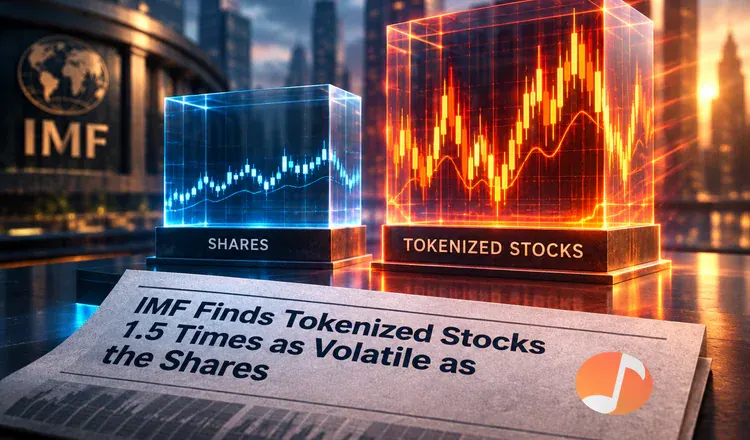
The IMF measured tokenized US stocks against the shares they track and found them about 1.5 times as volatile, and significantly less liquid. The finding sits in Chapter 3 of the October 2026 Global Financial Stability Report, released on 8 October as Scaling Tokenization: New Efficiencies, New Vulnerabilities. Three outlets read the chapter over the three days that followed and agree on that multiple. What they do not agree on is the benchmark used to size the market around it. The fund's own summary is blunter than any of the coverage.
Tokenized markets are "relatively illiquid and exhibit higher volatility than traditional counterparts," the accompanying fund post said.
Who is trading, and when
Two of the chapter's findings describe the demand side. More than half of tokenized equity trading happened outside regular US market hours, which run 9:30 a.m. to 4 p.m. in New York. About 80% of trades were for less than one share, so fractional buying is the normal size on these venues and not an edge case. Those overnight prices carry information. CoinDesk reports that more than 85% of overnight moves in the tokens showed up in the listed shares within five minutes of the open, while crypto.news puts the same measure at 87% to 99%. One is a floor, the other a range. They come out of the same chapter and they are not written the same way.
Two different equity markets to compare against
Size is where the readings split. All three accounts put public tokenized real-world assets at about $65 billion, excluding stablecoins, with tokenized equities roughly $2.3 billion of that; CoinDesk dates the snapshot to 31 July. To show how small that is, CoinDesk and crypto.news both cite SIFMA and put 2025 global equity market capitalisation at just under $160 trillion. Crypto Briefing, which filed two days earlier, uses $151.9 trillion for the global listed equity market and works the tokenized share out at 0.0029%. The two figures do not reconcile, and neither outlet shows how it got there. This desk's own count sits on a different footing again — RWA.xyz had the tokenized-stock token value at $2.54 billion on a later date than the fund's July snapshot, and from a different tracker.
Where the fund says the risk builds
The chapter's worry is not the current size. It is what the plumbing does at scale. Automated margin calls and liquidations, collateral that moves between platforms on its own, and round-the-clock trading could all make a shock harder to contain once the market is large enough to matter. The fund's post makes the inverse point about today's arrangements: messaging, trading, delayed settlement and reconciliation add friction and cost, and that same friction buffers risk and gives firms room to manage liquidity. A fully tokenized pipe takes the buffer away with the friction. Fragmentation is the other half of it. Issuance concentrates in a few jurisdictions while trading spreads across private platforms, public chains, custodians and settlement tools that often do not interoperate, which the fund ties to weak liquidity and poor price formation.
What a rulebook would have to settle
The recommendations put law ahead of technology: clearer legal rights over tokenized assets, liquidity safeguards, links between tokenized and traditional systems, consistent treatment of like activities whatever the technology, and settlement in money that is safe and widely accepted. Price feeds are the gap the chapter describes without naming. A comment letter filed on 9 October had Douro Labs asking SEC staff to set oracle standards for the kind of venue the chapter studied. Bitget chief executive Gracy Chen told CoinDesk that "moving assets onchain is only the first step" and that the harder question is how efficiently capital works once it is there, a comment that one outlet carried. The fund sets no deadline and proposes no rule. Its chapter is a measurement, and the next one is where the volatility gap either narrows as venues consolidate or does not.
Read also: SEC Gives Tokenized Stock Venues a Five-Year Exchange Exemption