
Greece Drafts Its First Crypto Tax at 10% With a €500 Exemption
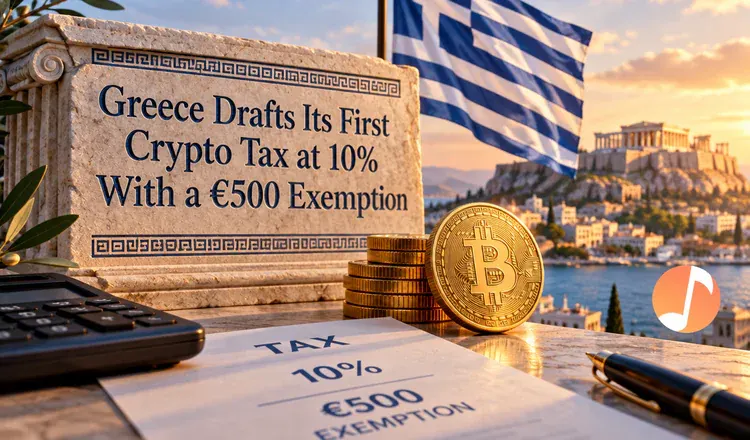
Greece has put a number on crypto gains for the first time. The Ministry of National Economy and Finance published a draft bill for public consultation on 7 October that would tax individuals' gains from transfers of crypto-assets at a flat 10%, leaving the first 500 euros of gains in a tax year untaxed. The rate is five points below the 15% that government officials described to Reuters in June. Consultation closes at 10 a.m. on 22 October, and the ministry wants the bill in front of parliament in November. The country has had no comprehensive statute covering crypto disposals until now.
What the draft taxes, and what it leaves alone
The gain is the transfer price less the acquisition price. Coins bought in successive batches are handled with an average acquisition cost, and the draft sets documentation rules for both sides of that calculation. Two provisions matter more than the rate to anyone who trades often. An exchange of one crypto-asset for another does not by itself create a taxable gain, on the accounts of Unchained and The Crypto Times, both of which read the draft text and published on 8 October. Returns from staking, lending and liquidity provision are treated as interest and taxed at the same 10%.
Unchained also reports that the draft imposes no digital transaction tax on crypto sales, and that payments in kind to employees, partners or shareholders are valued in euros at the time of acquisition. Neither detail appears in any other account read for this story, and that page discloses it was drafted with AI assistance and checked by an editor. The Crypto Times adds, alone, that crypto purchases would count toward the imputed living-expenses calculation Greek assessments use. Each of those claims rests on one outlet.
A 12-month window for sales already made
The draft also offers a way to settle the past. Taxpayers would have 12 months from the law's publication to declare gains on earlier transfers, a one-time voluntary-disclosure window both Unchained and The Crypto Times describe. The Crypto Times attaches a condition the other does not carry: pay the resulting tax within 60 days of declaring and no penalties or interest apply. Unchained's version says only that the relief comes under conditions set by the bill. The ministry's stated purpose, as The Crypto Times renders a Greek-language notice, is to close a legislative gap and give taxpayers certainty.
Where 10% sits in Europe, if the comparisons hold
The comparisons do not hold cleanly. Decrypt lists Cyprus at 8% since 1 January, Spain taxing gains as savings income at up to 28%, Ireland and Italy both at 33%, Germany exempting coins held more than a year, and the Netherlands taxing a presumed return instead of a realised gain. Unchained, citing Reuters, says European crypto rates run from 8% to 30%. A 30% ceiling cannot stand alongside two countries at 33%. We could not establish which figure supersedes which, and neither page shows the Reuters wording it rests on.
What the draft does sit inside is the bloc's new reporting machinery. DAC8 took effect on 1 January and obliges crypto-asset service providers to report their EU users' transactions, with 2026 the first reporting period. Supervisors have been tightening the perimeter all year, and the 8 January deadline for dropping stablecoins without MiCA authorisation is the most recent instance of it. Greece's own regulator is already in that record. Binance withdrew its application to the Hellenic Capital Market Commission in June before leaving the bloc altogether.
What nobody can price yet
No revenue projection exists. Officials told Reuters the Greek market is hard to size because most investors use platforms based outside the country, the same gap DAC8 reporting is meant to narrow. No account read for this story gives an effective date. The draft can change during consultation and again at the parliamentary reading, and the June figure already moved by five points once. What the ministry actually tables in November is the next thing that would settle any of it.
Read also: Illinois Enacts the First US State Tax on Digital-Asset Transactions