
Conduit Sues Tether Over $2.76 Million Frozen Since September 2025
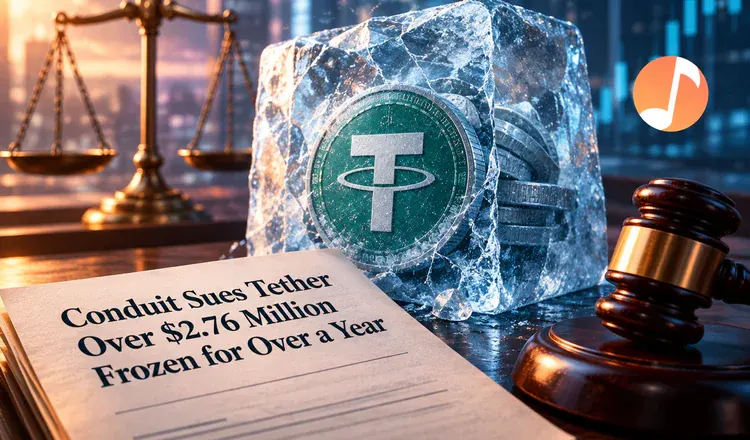
A payments company that lost its operating balance has taken the issuer of that balance to court. Conduit Technology sued four Tether entities in the U.S. District Court for the Southern District of New York over roughly $2.76 million of USDT frozen on 24 September 2025 and frozen still. The complaint says Brazilian federal police, whose investigation set the freeze in motion, never asked for Conduit's wallet. Tether had not publicly responded as of 7 October, by crypto.news's account. Five outlets date the filing 5 October; Cointelegraph says Monday, 6 October, and the Monday that week was the 5th.
What the wallet was doing before it stopped
Conduit began holding USDT in May 2025, on Cointelegraph's reading of the complaint. In the four months to the freeze the treasury wallet put through more than $1.1 billion across 4,427 transactions with 78 counterparties. Unchained and crypto.news carry all three figures and they agree. The complaint calls the wallet "the digital equivalent of the company's operating bank account." Conduit says the freeze forced layoffs and shut offices. No account gives a headcount.
Police sent a list, and the wallet was not on it
Brazilian federal police opened an investigation in 2024 into Bull Intermediação de Negócios and Onix Intermediações, two companies under shared ownership, and Onix had used Conduit's platform. Police passed suspect addresses to the T3 Financial Crime Unit, Tether's joint financial-crime operation, which then applied its own criteria in deciding what to freeze. The two accounts differ on who runs T3. Cryptopolitan describes it as a venture of Tether and TRON; crypto.news adds TRM Labs as a third founder, and the two do not reconcile. Conduit says police confirmed they "did not identify Conduit's wallet for freezing" and that it does not know "what evaluation criteria (if any) led Tether to freeze the funds." It also argues the treasury wallet "did not even exist when Onix was using Conduit's platform." A Brazilian court confirmed the firm was not under investigation, according to Cryptopolitan alone.
"Tether is not allowed to take money from businesses just because they chose to store that money in Tether's currency," the complaint said, in the wording Cointelegraph quotes.
What Conduit is asking for
The causes of action are conversion, unjust enrichment, breach of fiduciary duty and a claim under federal computer-fraud law, with protos also listing a count for declaratory judgment that Tether had no authority to freeze the tokens. The relief sought is an order releasing them, compensatory damages of at least $2.76 million, punitive damages, and an accounting of the interest and profits earned on the reserves backing the frozen balance. The damages figure is reported two ways. Crypto Briefing, protos and crypto.news describe at least $2.76 million plus unquantified punitive damages; Cryptopolitan puts it as the $2.76 million plus a further $2.76 million. Those readings do not reconcile. Unchained, which cites the docket, says a 19 August demand letter went unanswered. The same court is already holding a bigger version of the argument, where two Thai businessmen sued Tether over a $42.4 million USDT freeze at the end of August.
A power the issuer keeps asserting
How much Tether has frozen depends on what is being counted. Cryptopolitan gives a lifetime figure of more than $4.4 billion of assets tied to suspected crime. crypto.news says T3 on its own has frozen upwards of $450 million across earlier cases, and separately that Tether reported supporting freezes above $344 million of USDT in U.S. enforcement actions as of April 2026. Three scopes, three numbers, and no account reconciles them. Tether says it works with more than 340 agencies in 65 countries. The same capability is being built into token standards elsewhere, and Cardano this week shipped a standard that lets issuers freeze and seize. Paolo Ardoino, Tether's chief executive, said on 28 September that "Tether can act when credible information is provided by law enforcement," a line one outlet carries and one that predates the complaint by a week. No hearing date is set. Tether has filed no answer.
Read also: Tether Faces a Two-Year Countdown to GENIUS Act Compliance