
What Is Impermanent Loss in DeFi?
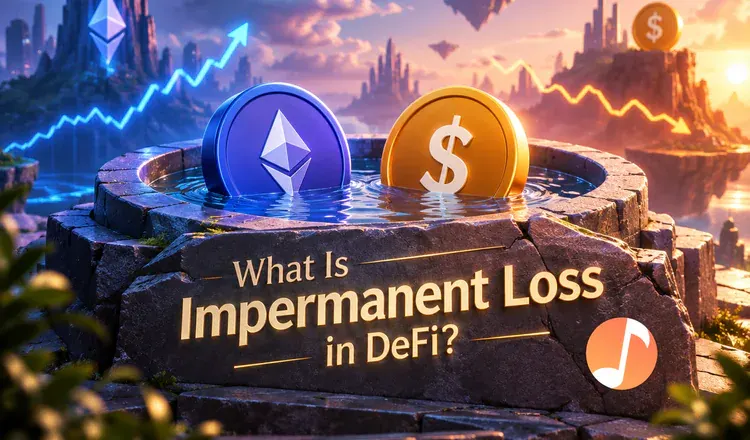
Impermanent loss is what happens when you put two tokens into a liquidity pool, their prices move apart, and you end up with less value than if you had just held the two tokens in your wallet. It is not a fee anyone charges you and nothing is stolen. It is the arithmetic of how the pool rebalances itself. The word impermanent is there because if the prices drift back to where they started, the gap closes again.
Why does the pool leave you worse off?
Picture a market stall that must always keep its basket exactly half apples and half oranges. When apples become fashionable and their price climbs, shoppers come to the stall and swap oranges for apples until the basket is balanced by value again. The stall did nothing wrong, but it sold apples all the way up and is left holding more oranges. A liquidity pool on Uniswap behaves in exactly that mechanical way: as the price of one token rises, traders buy it out of the pool, and your share ends up holding more of the token that fell and less of the one that rose.
How big is it in practice?
It depends entirely on how far the two prices separate. If you supply ether and a dollar stablecoin and ether doubles in price, your position is worth roughly 5 to 6 per cent less than if you had held both tokens untouched. If ether goes up fivefold, the gap is closer to a quarter. A pool of two stablecoins that both track the dollar barely moves apart at all, which is why those pools are the quiet corner of DeFi. If the mechanics are new to you, our guides to liquidity pools and automated market makers cover how the pool sets its prices.
What cancels it out?
Trading fees. Every swap through the pool pays the people who supplied it, and over time those fees are what liquidity providers are actually earning. A busy pool can pay enough to cover the gap comfortably; a quiet one with a volatile token often does not.
If you want to try it, start with a pair whose two sides tend to move together, and check the position against simply holding the same two tokens, not against the advertised yield. That comparison is the only one that tells you whether you came out ahead.