
Stopped Out, Then the Trade Goes in Your Direction: What Happened
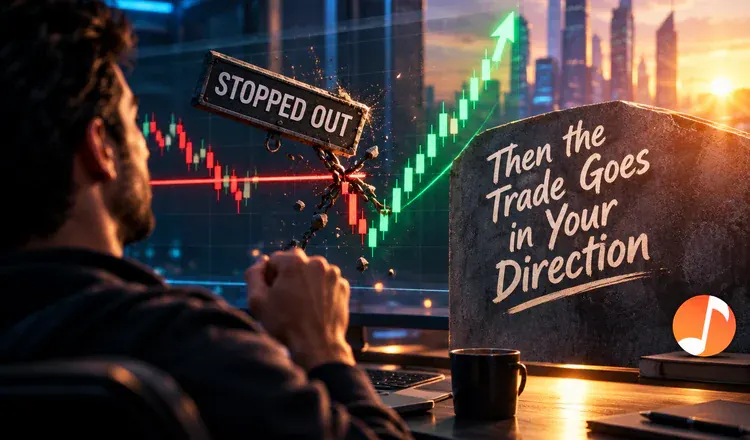
Getting stopped out and then watching the trade go your way means one of two things, and they need opposite responses. Either the market briefly dipped through a crowd of stops to collect sellers before continuing — a liquidity sweep — or your stop was simply too close for the coin's ordinary movement. The chart tells you which within a couple of candles, and the answer decides whether you change anything at all.
Which of the two was it?
Look at the candle that took you out. A long wick that pokes below an obvious low and closes back above it, on heavy volume, is a sweep: your stop was in the crowd. A slow drift that never travelled far, on an ordinary bitcoin afternoon, is a stop that was tighter than the market's normal breathing. Third possibility worth ruling out: the stop filled far from where you set it, which is slippage rather than either of the above.
The part that costs more than the stop
Watching the move run without you is the moment most accounts are damaged. Chasing the entry after it has already gone means buying late with no obvious level to place a new stop behind, usually with extra size to make up the miss. That is a revenge trade wearing a technical costume, and it is the same pattern under a different name. If you are angry, the next trade is not a trade.
Re-entering without chasing
Decide the rule before it happens. A workable one: you may re-enter once, only if price comes back and holds the level that stopped you, and only at the original size with the stop in a better place. If it never comes back, the trade is gone and that is a normal outcome — Bitcoin and Ethereum both produce several such moves a month, and none of them is the last one.
The durable fix is where you put the stop, not whether you use one. Give the obvious level real room, then size down so the wider stop risks the same money. Both halves are covered in why you keep getting stopped out on good setups and why price reverses right after taking your stop.