
Insufficient Liquidity for This Trade: What It Means and What to Do
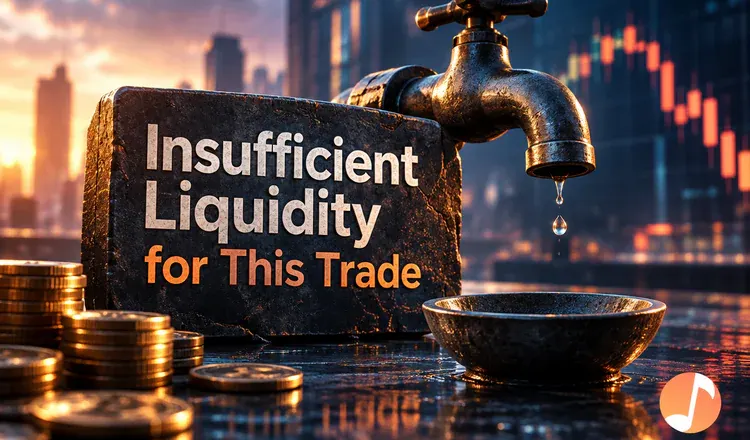
"Insufficient liquidity for this trade" means the pool you are trying to trade against does not hold enough of one of its two tokens to fill the amount you asked for. It is not a problem with your wallet, your balance or your connection. The market you picked is simply too small for the size of your order right now.
It is the village shop with two bottles of milk on the shelf. Nothing is wrong with the shop, and nothing is wrong with your money - you just cannot buy a crate there.
What liquidity actually is
A decentralised exchange like Uniswap has no order book. Instead people deposit pairs of tokens into a shared pot - a liquidity pool - and everyone else trades against that pot. Swap ETH for a token and you are adding ETH to the pot and taking the token out. Take too large a share out and the price inside the pot moves violently, so the exchange refuses the trade rather than fill it at an absurd rate.
Why you are seeing it
Three situations cover nearly all of them. The token is new or very small, and its pool holds only a few thousand dollars in total. You are on the wrong network - the token has deep liquidity on Ethereum and almost none on the chain your wallet is connected to, or you are holding a bridged version with its own much thinner pool. Or the pair does not exist at all: there is no direct route between those two tokens on that exchange.
What to do instead
Cut the size. Trading in several smaller pieces often works where one large order does not, and it costs you less in price movement. Check you are on the right network and holding the right version of the token - the contract address on the project's own site is the only reliable check. Try routing through a common pair such as ETH or USDC rather than token straight to token. And if a token can only be traded in tiny amounts, treat that as information about the token.
Never raise slippage to force a thin trade through - that is exactly how people end up buying at many times the fair price. Why a swap fails covers the other causes, and how to fix a swap failed error on Uniswap works through them in order.