
Aave Health Factor and Liquidation: What the Number Means
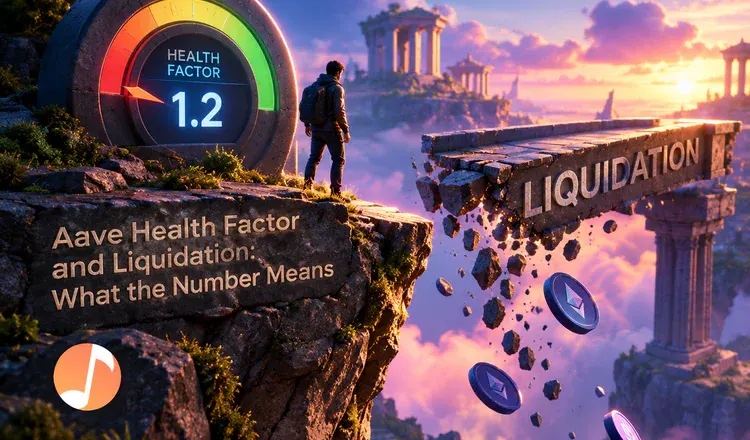
On Aave, the health factor is one number that tells you how close your loan is to being sold off. Above 1 you are fine. At 1 or below, anyone in the world can repay part of your debt and take some of your collateral in exchange. That is a liquidation, and it happens automatically, with no warning and no phone call.
How is the health factor worked out?
Think of a see-saw. On one side sits the crypto you deposited, on the other sits what you borrowed. Aave multiplies your collateral by a figure called the liquidation threshold - the share of that collateral it is willing to count as backing - and divides by your debt. Supply $10,000 of ETH with an 80% threshold, borrow $6,000 of USDC, and your health factor is 10,000 x 0.8 divided by 6,000, which is 1.33. Every asset has its own threshold, set by Aave governance, because a steady coin is easier to trust as backing than a thinly traded token.
What makes the number move?
Two things, and only two. Prices: if ETH falls, your collateral is worth less and the number drops. Interest: your debt grows a little with every block, so a loan left alone for a year drifts downward even when the chart is flat. You can push the number back up whenever you like, by repaying part of the debt or by depositing more collateral.
What happens below 1?
A liquidator - almost always a bot watching every Aave position at once - repays part of what you owe and takes the matching collateral plus a bonus, roughly 5% on blue-chip assets such as ETH and major stablecoins. Normally up to half the debt can go in a single step. If the health factor has slipped to 0.95 or below, the whole loan can be closed at once. What is left stays yours, and nobody chases you for more.
Look at the number before you borrow, not after. Anything under 1.5 is a warning light rather than a score. What counts as a good health factor puts sensible figures on it, and your liquidation price turns it into the number that actually matters: how far the market can fall before any of this happens.