
An SK Hynix Perp Flash-Crashes on a Hyperliquid Market
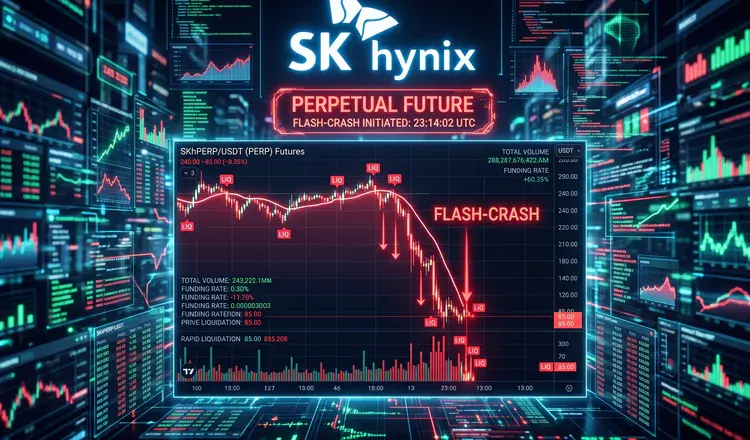
A perpetual futures contract on SK Hynix shares, listed on a market trade.xyz operates on Hyperliquid, fell sharply within seconds after one share changed hands on a South Korean venue at 29.96% below the previous close. The market's price feed treated that venue, the alternative exchange NextTrade, as its primary source, so the print carried straight into the contract's mark price, the reference an exchange uses to value open positions and decide when to force-close them. The mark fell from $1,127.90 to $917.25, a drop of 18.7%, and leveraged long positions were liquidated on the way down. Nothing was hacked. The market acted on the price it was handed, and the published accounts of how much damage that did, and exactly when, do not match.
A perpetual on one company's shares
A perpetual future is a derivative with no expiry date, kept near the price of what it tracks by periodic funding payments between the long and short sides. Most perpetuals track crypto assets. A single-equity perpetual tracks one listed company's shares instead, here the Korean memory-chip maker SK Hynix, while margin and settlement stay in crypto. Hyperliquid did not list this market itself. It was deployed under HIP-3, the framework that lets outside teams launch and run their own perpetual markets on the exchange's infrastructure, with the deployer posting collateral and taking operational control. trade.xyz deployed and operated the SKHYNIX market, posted the required 500,000 HYPE, about $27.4 million, as collateral, and controlled the price feed the market settled against.
One share at 29.96% below the prior close
In the South Korean pre-market session, one SK Hynix share traded on NextTrade, the country's alternative exchange, at 29.96% below the prior close. The market's oracle, the service that reports an off-chain price on-chain, tracked that venue as its primary source, so the print set the perpetual's mark with no offsetting reference. The won-denominated account does not quite line up with the dollar one. It gives an abnormal print of 1,272,000 won against a prior close of 1,785,000 won, an implied fall of 28.7%, and puts the perpetual's decline at 17.9% rather than the 18.7% implied by the dollar marks. Any venue that values positions against an outside price it does not produce itself inherits whatever happens at that source.
Three totals on the record
A liquidation cascade is mechanical. When the mark drops below the maintenance margin on a leveraged long, the exchange closes that position at market, and that forced sale pushes the mark lower for everyone still open, closing the next position, and so on until the move stops. What the cascade cost is where the accounts split. BeInCrypto reported about $57.4 million of long positions liquidated across 960 accounts, with $17.3 million of realized losses for longs and $10.8 million of shorts closed by auto-deleveraging, the mechanism that force-closes profitable positions when the losing side's collateral cannot pay them. The analytics firm Lookonchain, cited by crypto.news, put the figure at more than $80 million of SKHX positions liquidated, a number trade.xyz has not confirmed. CoinDesk carried the episode at $60 million. None of the three explains the gap to the others, and we could not establish which figure is closest. How far the cascade ran depended on how much leverage sat in the market that week.
A fall that stayed inside the published bounds
The timestamps differ too. crypto.news dated the anomaly to 27 July at 23:01 UTC, while BeInCrypto's account places it during Seoul trading hours on 28 July. Set side by side, the two reconcile arithmetically, since 23:01 UTC on 27 July is 08:01 KST on 28 July. Hyperliquid's position was that it supplies infrastructure only, "different teams can deploy and operate markets," it said, and that the contract behaved exactly as its published design specifies. That design includes discovery bounds, limits on how far a mark may travel in one step: a 10% instantaneous move with one permitted reset, capping the total at 19% below the session reference. The 18.7% fall sat just inside that ceiling. The practical questions stay open: whether a single venue should serve as a market's primary price source, whether HIP-3 deployers face any standard on feed construction, and who absorbs losses produced by one share trading far from every other quote.
Read also: Tether Gold Gets a Shariah Compliance Certification