
Open USD Unveiled With 140+ Backers as Circle Falls Over 17%
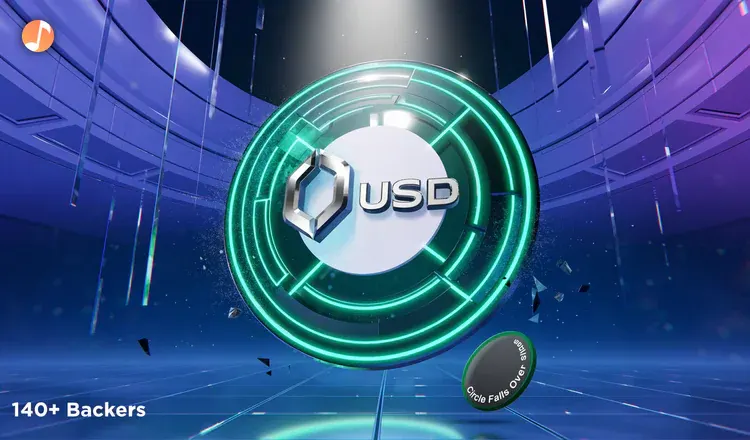
A group of more than 140 companies unveiled a shared dollar stablecoin on 30 June, and the design goes straight at the revenue that funds the largest existing issuers. The token, Open USD (OUSD), comes from Open Standard, a new organization led by founding chief executive Zach Abrams. Under the announced terms, businesses will be able to mint and redeem OUSD without fees and with no volume caps, and the income earned on the reserves backing the token will be returned to participating partners, less a management fee. Stripe, Coinbase, Visa, Mastercard and BlackRock are among the named backers. Circle, one of the two incumbents the model targets alongside Tether, fell more than 17% and closed below $63.
The business the float pays for
A dollar stablecoin is a token meant to hold a fixed value of one US dollar, backed by reserve assets the issuer holds against every token in circulation. Issuers generally do not charge for the transfer itself. The money is made on the float, the pool of reserves standing behind tokens in circulation, and the interest income that pool generates stays with the issuer. The arrangement scales with the amount outstanding, so issuers compete on distribution; every additional token in circulation adds to the reserve pool without adding a proportional cost. The announcement puts OUSD squarely against that arrangement, the one that currently funds both Circle and Tether.
Free minting, with the float paid back out
The consortium's design removes both sides of that equation. Minting and redemption are to be free and uncapped, so a business moving large volumes faces no issuance cost and no ceiling on how much it can create or redeem. The reserve income is to be passed back to the participating partners instead of accruing to a single company, with Open Standard retaining a management fee. Governance follows the same logic: an independent board composed of the partners, not a single issuer, so decisions about the token do not rest with one firm whose revenue depends on the float. For a payments company or a merchant platform, the pitch is that the economics of holding and moving dollars on-chain flow back to the businesses generating the volume.
Who signed on
Open Standard named more than 140 partners at launch, spanning card networks, banks, asset managers, commerce platforms and crypto infrastructure. Among them:
- Payments and cards: Stripe, Visa, Mastercard, American Express, Mercado Pago.
- Banks and asset managers: BlackRock, BNY, Standard Chartered, DBS, U.S. Bank, BBVA.
- Crypto and custody: Coinbase, Ripple, Solana, Polygon, Aave, MetaMask, Fireblocks, Anchorage Digital.
- Technology and commerce: Google, IBM, Samsung, Shopify, Crypto.com.
The effort is led by Zach Abrams, who co-founded Bridge, acquired by Stripe in 2024, and who was earlier a product lead at Coinbase. That background places the consortium closer to the payment processors that route stablecoin volume than to the issuers that mint it.
A token that does not exist yet
Circle shares ended the day down more than 17% at under $63, a four-month low and roughly 55% below where they traded in mid-May. The market reaction hit the incumbent, not the newcomer. Circle's chief executive publicly questioned the viability of the model. Much of the proposal was still unspecified at announcement. The token was slated to go live later in 2026, and no host chain was named. What matters next is whether the named partners route real volume through OUSD once it exists, and whether an issuer-less board can move as fast as a single company.
Read also: New York Life's $807B Arm Debuts Tokenization With Centrifuge