
Base vs. Arbitrum: The Great RWA Liquidity Tug-of-War in 2026
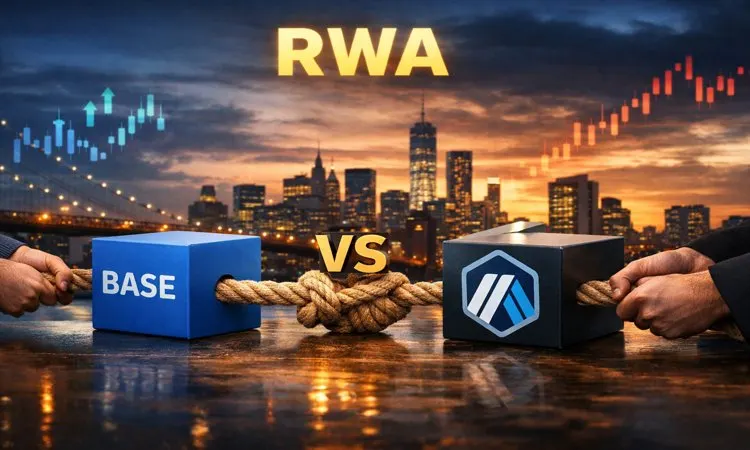
In 2026, tokenized real-world assets are no longer a narrative experiment. Instead , RWA has become a core infrastructure reality. The question is no longer whether the sector will grow; rather , the real challenge is identifying where liquidity will concentrate.
A year ago, the focus was primarily on regulators. Today, however , attention has shifted Deeper — to Settlement layers. As we previously analyzed in our breakdown of Paul Atkins’ regulatory vision, institutional transparency became the foundation of this new cycle. Nevertheless , regulation is only the top layer, beneath which infrastructure is fiercely competing. Specifically , in 2026, that competition is largely between Base and Arbitrum.
Why Liquidity Matters More Than Speed
In the RWA sector, the fastest network doesn’t necessarily win. Consequently , the network where capital feels most secure takes the lead. What matters most includes:
-
Stablecoin liquidity depth
-
Regulatory clarity
-
Institutional accessibility
-
DeFi composability
Furthermore , RWA tokens represent legally structured assets with custodians and reporting obligations. They require trust — not just raw throughput.
Base: The Institutional Gateway Layer
Base was built in close alignment with Coinbase. As a result , in 2026, that connection is not just technical; it is strategic. Coinbase has effectively become a bridge between US financial institutions and on-chain infrastructure. For instance , players such as BlackRock (through its BUIDL fund) and Ondo Finance favor infrastructures that align with clear regulatory logic.
Moreover , Base offers several key advantages:
-
Built-in KYC pathways
-
Transparent onboarding structures
-
Direct access to the largest US crypto client base
This architecture fits neatly within the SEC’s evolving approach. While Base wins on institutional trust, the trade-off remains a higher degree of centralization.
Arbitrum: Liquidity as an Ecosystem
Arbitrum approached RWA from the DeFi side. By 2026 , it maintains one of the deepest native liquidity environments among Layer 2 networks. Its Ecosystem includes large credit markets and active DAO governance. In addition , derivatives platforms like GMX play a crucial role.
If Base is optimized for issuance, then Arbitrum is optimized for circulation. On Arbitrum, tokenized assets can be used as collateral or integrated into lending protocols. Indeed , the composability advantage is significant. Deep stablecoin pools also create fertile ground for automation. This is where advanced AI-driven capital strategies are increasingly deployed — allowing risk-weighted assets to be utilized dynamically within DeFi frameworks.
Quick Comparison
| Metric | Base | Arbitrum |
| Core Strength | Coinbase integration & compliance | Deep DeFi composability |
| Primary Audience | Banks, asset managers, issuers | Traders, DAOs, DeFi protocols |
| Infrastructure | Account abstraction, smart wallets | Orbit (L3 expansion chains) |
| RWA Role | Issuance & institutional onboarding | Secondary markets & strategy |
Clearly , this isn’t just a competition of technology — it’s a competition of models.
Risks Rarely Discussed
-
Liquidity Fragmentation. If RWA issuance and trading split across multiple L2s and L3s, depth could weaken. As a result , capital may become more mobile but less concentrated.
-
Sequencer and Automation Risk. Cross-chain bridges and multi-layer custody introduce structural vulnerabilities. Moreover , in 2026, risk comes from automation. Algorithmic strategies can amplify volatility during stress events. We explored how AI is reshaping market structure in our analysis, “Artificial Intelligence and Crypto Trading in 2026: Risks and Realities“.
-
Regulatory Shifts. Changes in US Positioning could redirect issuance flows. While this may reinforce Base’s dominance, it introduces uncertainty for Arbitrum.
Three Possible 2026 Scenarios
-
Scenario 1: Base Dominance. Most regulated RWA issuance consolidates within the Coinbase ecosystem.
-
Scenario 2: Arbitrum Gravity. RWA integrates Deeply into DeFi markets, strengthening Arbitrum’s native liquidity.
-
Scenario 3: Structural Split. Base becomes the issuance layer, while Arbitrum becomes the circulation layer.
At this stage , the third scenario appears the most structurally resilient.
🎷 The Crypto-Jazz Editorial View
We don’t see this as a zero-sum competition. Instead , Base and Arbitrum represent two complementary architectural philosophies. One prioritizes institutional predictability, while the other enhances financial flexibility.
Markets rarely choose absolutes; rather , they choose balance. RWA issuance will likely gravitate towards environments with regulatory clarity. Meanwhile , secondary liquidity will develop where DeFi infrastructure is deepest. This balance — not ideology — will define the map of tokenized finance.
📡 We publish short-form RWA updates and market Insights on Telegram before full research articles go live. Follow Crypto-Jazz to see the shift before it becomes consensus.