
XRP Ledger's Batch Amendment Sits One Validator Short of 80%
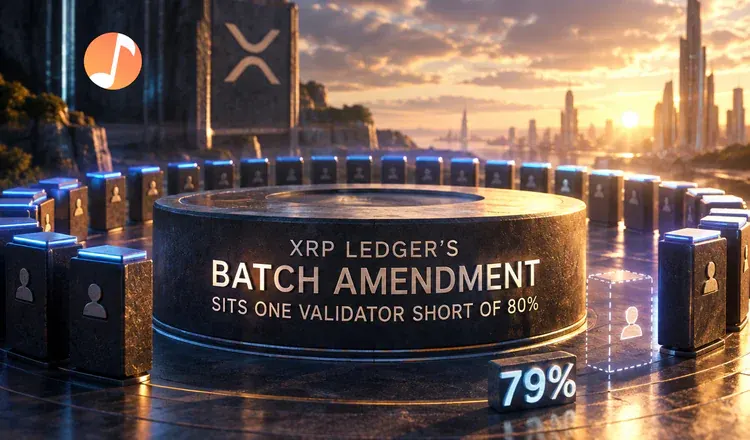
Twenty-seven of the XRP Ledger's 35 trusted validators were backing the BatchV1_1 amendment on Tuesday, roughly 77% of the list and short of the 80% the network asks for. One more yes vote would start a fourteen-day holding period, and the change activates at the end of it if support holds. Batch lets an account submit up to eight transactions as a single package that either all succeed or all fail. This is the rebuilt version of a feature pulled in February over a signature flaw, and it has sat in front of validators since early August. No activation date has been published by anyone.
What bundling eight transactions buys
An amendment on the XRP Ledger is a change to the consensus rules that ships dormant inside the server software and waits for a validator vote. Batch is the change application developers have waited longest for. Without it, a swap between two parties has to be assembled out of separate transactions with somebody standing behind them to make sure both legs land. CoinDesk and crypto.news, filing within hours of each other on Tuesday, give the same worked examples: a token swap, a customer payment combined with a marketplace fee, a multi-step transfer. crypto.news is alone in this sweep in setting out four execution modes, called all or nothing, only one, until failure, and independent. Take that detail as one account's.
Twenty-eight or twenty-nine
The bar itself is reported two ways. CoinDesk, filing at 05:58 UTC on Tuesday, says a single further vote would start the countdown, which puts the requirement at 28 of 35, or exactly 80.00%. crypto.news, writing a week earlier from 24 votes, says the amendment needs support exceeding 80% and that at least five more validators had to come across, which puts the bar at 29. Those are not the same threshold, and neither account acknowledges the other. The identical ambiguity ran through the vote on the bundle of protocol fixes that cleared the bar on 11 September, where one outlet described the requirement as 28 validators and another as roughly 29.
The climb has been steady. Support stood near 68% on 7 September, at 24 of 35 the following day, and at 27 on Tuesday. Two accounts published on 7 September said activation could come by the end of this month if the pace held, and both said it is not guaranteed. Support has to stay above the bar for the whole fourteen days once the clock starts. If it slips, the countdown resets.
Eleven fixes, one of them critical
RippleX set out on Monday what the rebuilt version repairs. Eleven issues were found and corrected, covering transaction signatures, authorisation checks and conditions that could crash a server. Common Prefix rated one of them critical: an attacker could have reused signed permissions for transactions the signer never meant to authorise. The review ran to four senior engineers, audits by Halborn and Common Prefix, a public Sherlock contest and automated testing. The original flaw surfaced in February, before the amendment reached the main network, and XRPL Labs said at the time that no user funds were placed at risk.
"After the v1.0 signature bug was caught in February (pre-Mainnet, no funds at risk), we rebuilt it," Mayukha Vadari, a software engineer at RippleX, said in wording carried by crypto.news.
Nobody has named a customer
RippleX told CoinDesk that commercial projects built on Batch are under contract or in development. It named none of them, and no second account in this sweep carries the claim. The code shipped inside xrpld 3.3.0 on 6 August alongside confidential transfers, and most of what travelled with it is still switched off. The lending protocol, single-asset vaults and confidential transfers all remain disabled on mainnet. What happens next is a validator decision and nobody else's. Twenty-eight votes starts a clock, or twenty-nine does, and the published accounts do not agree on which.
Read also: Ripple Sets Out a Four-Stage Path to a Quantum-Safe XRP Ledger