
Measuring the Real Cost of Premium Assets in Bitcoin
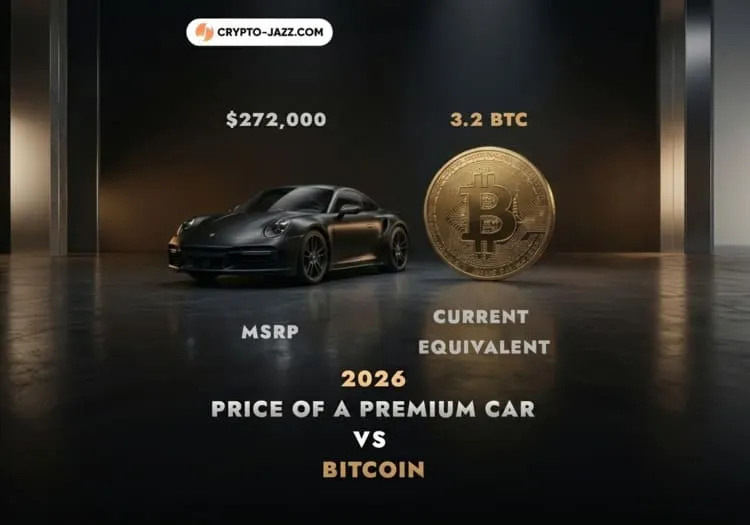
In traditional financial systems, luxury assets continuously become more expensive. Due to global inflation, supply chain shifts, and fiat currency devaluation, the retail price of premium vehicles climbs higher every year. However, when we shift our unit of account from inflationary fiat money to hard digital assets, the market dynamic changes completely.
To understand the long-term expansion of Bitcoin purchasing power, we can look at a consistent benchmark in the automotive industry: a brand-new flagship premium sports car.
A decade of structural pricing shifts
Over the last decade, the manufacturer’s suggested retail price (MSRP) of a top-tier premium vehicle in US dollars has increased by roughly 70%. For the average consumer saving in fiat currency, such an asset has become significantly harder to acquire.
Yet, for investors utilizing the Bitcoin standard, the real cost of the vehicle has plummeted by more than 99%. Here is how many Bitcoins were required to purchase a flagship sports car at different market intervals over the last 12 years:
-
2014: ~343 BTC (Average MSRP equivalent of $182,000)
-
2016: ~355 BTC (Reflecting a local market correction in BTC price)
-
2020: ~23 BTC (Post-halving accumulation phase)
-
2026: Just 3.2 BTC (Current showroom price equivalent)
This dramatic decrease demonstrates that the luxury product itself did not become easier or cheaper to engineer and manufacture. Instead, it highlights how effectively Bitcoin compounds value over multi-year horizons compared to traditional fiat currencies like the US Dollar or the Euro.
The mechanics of pricing under a deflationary standard
The core reason behind this shift is the fundamental difference in scarcity. Fiat currencies operate under an expanding supply model. Central banks regularly increase the money supply, which dilutes the value of existing capital and drives up the nominal cost of goods, property, and luxury items.
In contrast, Bitcoin operates on a fixed supply of 21 million coins. As global demand, institutional adoption, and infrastructure integration grow, the value of each individual Satoshi increases. This framework expands your long-term purchasing power, allowing a fixed amount of capital to command a much larger share of real-world assets over time.
Comparing hard money and inflationary systems
While traditional financial products and savings accounts struggle to keep pace with real-world inflation, digital assets serve as an alternative framework for capital preservation.
The comparison between a luxury asset and BTC shows a clear macroeconomic reality:
-
Fiat Systems: Quietly erode the value of accumulated labor and savings over time.
-
Deflationary Systems: Protect capital from monetary debasement and act as a reliable shield for long-term holders.
For institutional allocators and retail savers alike, understanding how Bitcoin purchasing power interacts with real-world consumer goods is essential for long-term wealth preservation.